A common question asked of Effective Cycling Instructors is, "What tools should I carry
with me on rides?" Unfortunately, there is no one correct answer. Ask yourself these three
questions to determine what you should carry.
1) What do I know how to repair? Carrying two pounds of tools that you don't know how to use
will help only if a Good Samaritan who knows about bikes happens along. Only carry tools for work
that you know how to do.
2) How well do I maintain my bike? A lack of maintenance at home ensures a greater likelihood
of a specific bike failure occurring. If you regularly check your derailleur cables for damage,
corrosion, and wear, you shouldn't have to carry equipment to replace one. Be sure to check your
tires for proper inflation before each ride and maintain adequate lubrication of the chain.
 3) How far from civilization will I be riding? If you do only day rides close to home, flat tire
tools and a quarter for the phone may be enough. For loaded touring, you'll probably want a larger
kit including a freewheel tool, spare spokes, crank puller, and more.
3) How far from civilization will I be riding? If you do only day rides close to home, flat tire
tools and a quarter for the phone may be enough. For loaded touring, you'll probably want a larger
kit including a freewheel tool, spare spokes, crank puller, and more.
Although each bike has different tool needs, most bikes today are standard to the extent that the
following list will handle the majority of on-road repairs and adjustments:
- Tire levers
- Spare tube
- Hand pump (better than CO2 because it never runs out of air)
- Patch kit (to fix the occasional second flat on one ride)
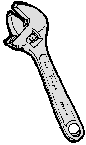
- Adjustable wrench, 6" (for most hex bolts)
- Screwdrivers (straight & Phillips head as needed)
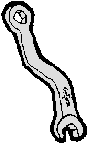
- Box wrenches or open/box combination (as appropriate for your bike where the 6" adjustable wrench
may not fit; also available are 8-9-10 mm "Y" wrenches and metric "ignition wrench" sets)
- Hex (Allen) wrenches of 4, 5, and 6 mm (or a "Y" wrench of these sizes)
 Look this list over and compare it with your bike's needs for such things as derailleur adjustments,
brake adjustments, handlebar or rack tightening, wheel removal, and saddle adjustments. Be sure
you understand what tool is needed for each fitting on your bike, and then alter the above list of
tools as needed.
Look this list over and compare it with your bike's needs for such things as derailleur adjustments,
brake adjustments, handlebar or rack tightening, wheel removal, and saddle adjustments. Be sure
you understand what tool is needed for each fitting on your bike, and then alter the above list of
tools as needed.
Always remember that tools don't fix things - people fix things. A good way to learn how to make
repairs on your bike is by taking a course from an Effective Cycling Instructor. Many ECIs offer
maintenance-only courses, especially in winter.
Reprinted from "Bicycle USA", magazine of the League of American Bicyclists.
For more information about the League of American Bicyclists, visit
their web site, www.bikeleague.org,
or e-mail them at bikeleague@aol.com.
